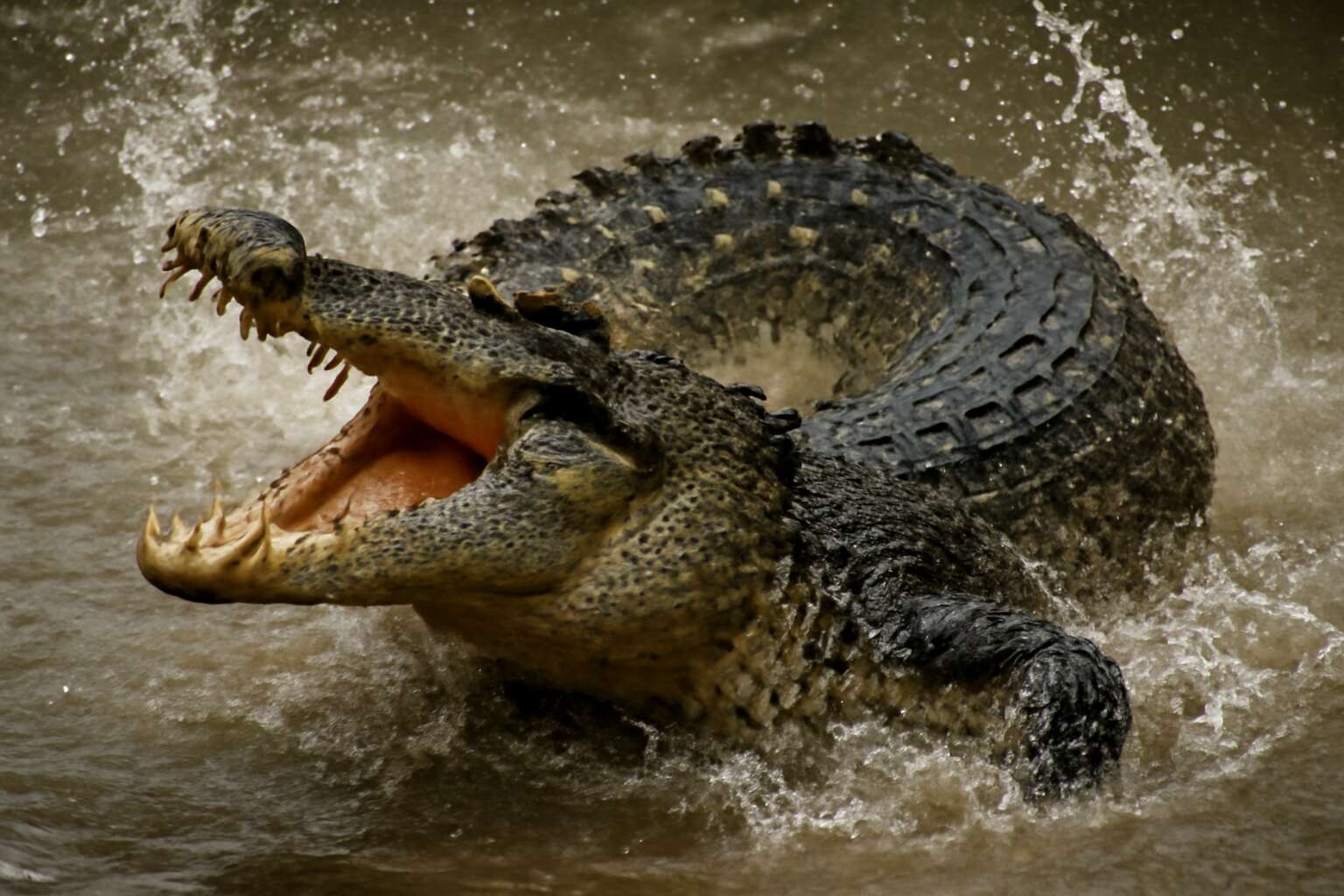
Anatomy and Mechanics
Across South Africa’s sunlit rivers, the crocodile death roll unfolds in a heartbeat—a controlled cyclone of power that braids water and prey in under a second. It’s biomechanics in motion, where a single spine twist and a surge of tail muscle coordinate with eerie precision. The river’s hush carries an almost supernatural sense of purpose!
- Jaw and neck architecture lock prey immediately, initiating the roll
- A flexible spine and powerful oblique muscles drive rapid, sweeping twists
- The tail acts as a lever, delivering propulsion and stabilizing the arc
Anatomy and mechanics fuse in a precise choreography: the head clamps and holds; the torso twists with hydraulic rhythm; the tail provides propulsion and steering. The arc is muscular, timing surgical, and water resistance becomes an ally rather than a hurdle.
Behavior and Ecology
In South Africa’s sun-washed rivers, patience is a predator’s currency. The crocodile death roll may be the dramatic centerpiece of a feeding strike, yet behavior stretches far beyond that single move, shaped by prey migrations, water levels, and seasonal floods that choreograph ambush opportunities.
Most crocs are solitary, fiercely territorial hunters who rely on stealth over speed. They bask to regulate temperature, slip through reeds with startling quiet, and favor crepuscular hours when wary prey hauls itself to the bank for a drink.
Beyond hunting, social tempo is subtle: ritual displays deter rivals, and mothers guard nests with a vigilance that offsets the risks of a volatile riverine life. The ecology of these rivers—fish, birds, and even hippo—creates a web that supports and constrains every bite.
Safety and Public Education
Rivers hum with a quiet audience in South Africa, where safety in the wild is a shared responsibility and gentle awe is part of the curriculum. Public education programs keep communities alert and schools informed about river etiquette, local habitats, and why boundaries exist between crowds and crocs.
The crocodile death roll may headline predator theatrics, but safety messaging stays constant: respect, distance, and observation. By weaving wildlife literacy into everyday life, we turn near-misses into knowledge, not bravado, and keep rivers as classrooms rather than danger zones.
- Maintain a respectful distance from river edges
- Respect posted warnings and reserve areas
- Never feed or attempt photos at close range
Public education in South Africa’s riverine landscapes works best when all ages share the same silent agreement: the river teaches, but only if we listen!
Cultural and Scientific Perspectives
Rivers remember: “The river is louder than the pause,” a guide once said. The crocodile death roll is not merely a predator’s flourish but a crucible of physics and perception, a rapid choreography that tests hunter and observer alike. In South Africa’s riverine cultures, this act becomes a mirror—showing how awe and restraint cohabit in our relationship with danger. What is the price of power in this watery theatre! Science reads it as a biomechanical marvel; culture as a lesson in balance with the river.
From the river’s edge, perspectives diverge in thoughtful ways:
- Indigenous lore, power tempered by restraint.
- River etiquette and habitat boundaries inform behavior.
- Biomechanics reveals precise mass and timing.
- Ethical questions emerge about coexistence.
Viewed together, these cultural and scientific lenses illuminate the crocodile death roll as more than spectacle; they map memory, responsibility, and the uneasy contract between humans and a living river across South Africa.

0 Comments