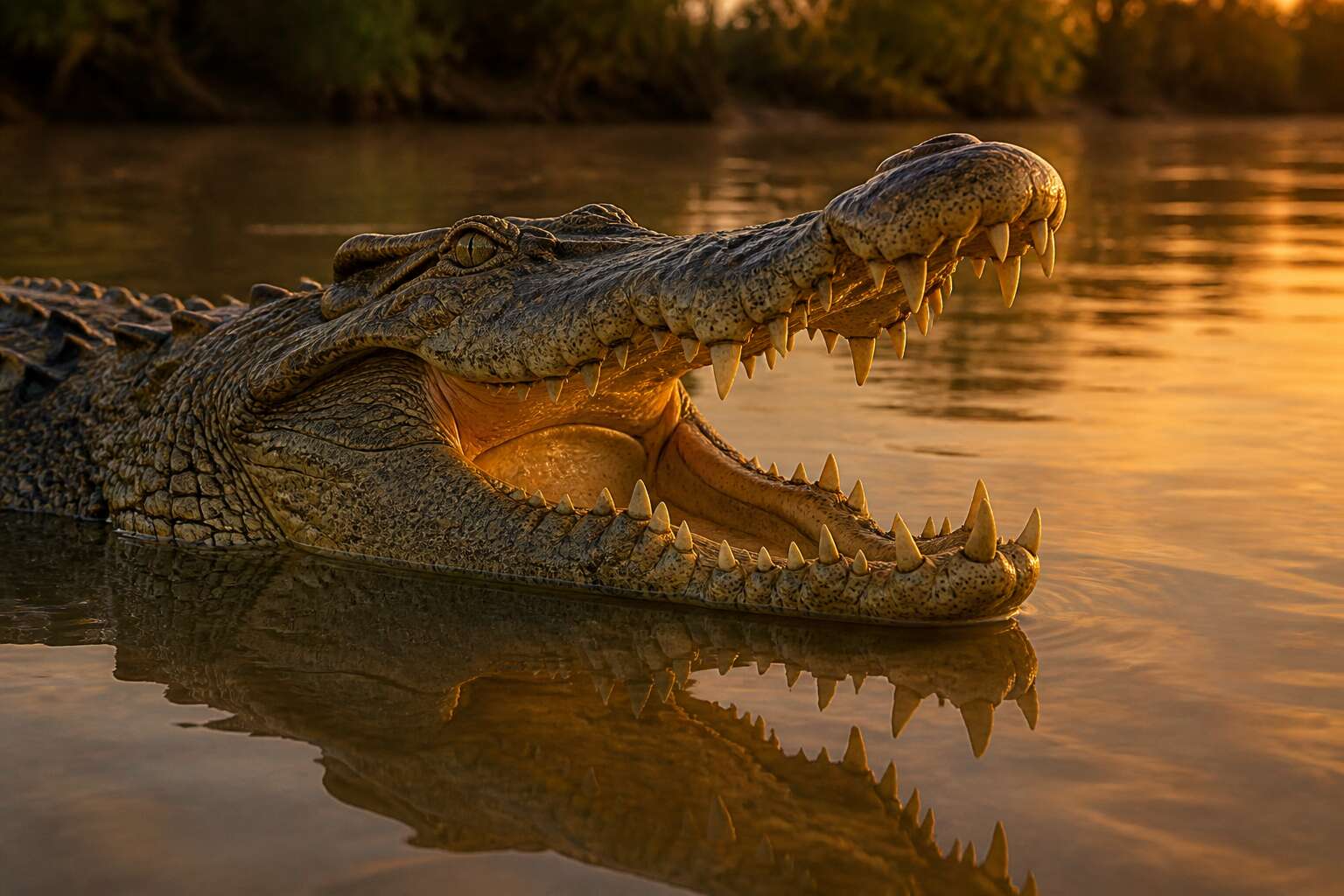
Understanding the Crocodile’s Predatory Nature
Crocodile Species Known to Attack Humans
The Nile crocodile kills more humans each year than any other crocodilian. I have seen the stillness before its strike! This is not random violence; it is an outcome of predatory nature refined over millions of years. A crocodile can eat human flesh readily because its jaw structure, digestive acids, and ambush tactics are engineered for large prey. Beneath the water, it perceives motion as opportunity.
Certain species are infamous for these encounters:
- Nile crocodile
- Saltwater crocodile
- Mugger crocodile
- American crocodile
The saltwater crocodile, the largest living reptile, treats humans as territory intruders. The Mugger, though smaller, has a history of attacks across South Asia. These predators do not hunt with hunger alone; they also defend their domain. Understanding that crocodile can eat human beings means respecting the silence of the water. That silence holds an older power.
Size, Strength, and Jaw Power Capabilities
A six meter saltwater crocodile brings more than mass to a confrontation. Its jaw exerts over 3,700 pounds per square inch. That force grips prey with conical, serrated teeth designed to hold rather than chew. Even smaller adults can bite through a human femur.
The fact that crocodile can eat human is not a mystery. Stomach acids dissolve bone and keratin, leaving almost no trace. Add a strike speed from the tail that propels the body forward in less than a second. The predator does not chase. It waits and strikes.
- Bite force exceeds 3,700 psi.
- Swimming burst speeds reach 20 kph.
- Jaw closure completes in 0.1 seconds.
Each measurement describes a single reality. Once those jaws lock, no human strength pries them open. The calm surface hides this power completely!
Hunting Instincts vs. Opportunistic Feeding
Documented Incidents and Statistics of Human Predation
Global Attack Statistics and Fatality Rates
Globally, crocodiles account for hundreds of fatalities each year, with estimates ranging from 500 to over 1,000. That figure is sobering. In sub-Saharan Africa, the Nile crocodile is responsible for most attacks. One recent study documented 94 attacks in a single Tanzanian region over five years, and most were fatal.
The reality is that a crocodile can eat human prey, and documented cases confirm it. Statistics from Australia and Southeast Asia show saltwater crocodiles kill dozens annually. In many rural communities, victims are often fishermen or children fetching water.
Consider these documented patterns:
- Fatal attacks cluster near riverbanks and lake edges.
- Most incidents occur during the warmer months when crocodiles are more active.
- Local fatality rates undercount remote incidents.
These numbers represent grieving families, not just data points.
Case Studies of Notable Fatal Attacks
The Ruhudji River case is brutal! In 2008, a Nile crocodile dragged a 14 year old boy from the shallows while his mother watched. Villagers found the reptile’s stomach two days later. That is what a crocodile can eat human prey means in practical terms.
Then there is the Kusini crocodile in Kenya, which claimed 16 victims over three years before hunters shot it. Documented attacks from southern Africa follow the same pattern:
- A fisherman in Mozambique vanished from his canoe in 2019. Search teams recovered his boots and a severed hand in a crocodile den.
- In South Africa’s Limpopo River, a 35 year old man was attacked in 2021 while retrieving cattle. Rangers killed the crocodile and found his remains.
These incidents confirm that a crocodile can eat human victims within minutes. The attacks are not random. They happen where crocodiles live and people work.
Myth vs. Reality: Are All Crocodiles Man-Eaters?
Man eating crocodiles are rare, not typical. A two decade review of attacks in South Africa recorded 64 incidents, and only 18 were fatal. The rest involved defensive strikes or territorial disputes. Most crocodiles, when confronted, retreat.
The phrase crocodile can eat human prey is factual, but it describes capacity, not intent. Nile crocodiles are opportunistic feeders, yet they prefer fish, frogs, and wildebeest. People are difficult prey. We are tall, loud, and often in groups.
- A single crocodile in Burundi killed a dozen people between 1998 and 2002.
- In Zambia, a 4.7 meter reptile attacked four fishermen in one season.
- These outliers represent a fraction of a percent of crocodile populations.
Wildlife authorities agree that most Nile crocodiles never attack a person. The label man eater applies to individuals that learn human habit. Even then, a crocodile can eat human flesh without hunting people. Scavenging explains many cases.
The Mechanics of a Crocodile Attack and Consumption
The Ambush: Stealth, Speed, and Surprise
The crocodile can eat human prey, but the act is less a deliberate hunt and more a study in violent opportunity. The entire attack hinges on a paradox: immense, cold power wielded with sudden, explosive grace. The water’s surface might be a placid mirror, reflecting the sun, while below, a prehistoric killer has already completed 90% of its lethal work.
The ambush begins with stillness. A crocodile can remain entirely submerged for over an hour, its eyes and nostrils barely breaking the surface, resembling two innocuous bumps on a floating log. This is the stealth phase, a period of profound patience that lulls the most cautious observer into a false sense of security. Their dark, mottled skin provides perfect camouflage against the muddy riverbeds, rendering them nearly indistinguishable from their aquatic environment.
When the moment arrives, speed becomes the defining factor. The strike is a brutal, instantaneous acceleration of muscle and bone. There is no warning, no ripple of disturbance, just a sudden eruption of chaos. The crocodile launches its body upward and forward in a motion that is both terrifyingly swift and devastatingly powerful. This initial lunge is designed to close the distance before the prey can even register the threat.
The mechanics of the attack often determine the immediate outcome.
– The strike zone is limited to a few crucial feet of water, forcing the crocodile to act from very close range.
– The tail acts as the primary propulsive engine, providing the thrust for the explosive lunge.
– Misdirection plays no role; the attack is a pure, unadulterated power surge.
If the initial bite fails to kill, the crocodile’s next action is a hydraulic, writhing death roll that disorients and drowns the victim. The sheer force of this maneuver is designed to tear limbs and crush bones, turning a struggling animal into a manageable meal. This entire sequence, from submerged vigilance to a violent, final dispatch, typically lasts under a minute, which is why a crocodile can eat human remains with such terrifying efficiency. Witnesses in places like the Okavango Delta or the Kruger National Park often report hearing a splash and a scream, followed by an unnerving silence that signals the end of the encounter.
The Death Roll: How It Overpowers Large Prey
When a crocodile secures a grip, the outcome is rarely in question. The jaws lock with a force measured in thousands of pounds, and the prey’s struggle only accelerates the process. The famous death roll is the definitive mechanism here. It is not a random thrash; it is a calculated, rotational burst that leverages the crocodile’s entire body mass.
The sequence is brutally efficient:
1. The crocodile holds the limb or head firmly in its jaws.
2. It tucks its legs against its body to reduce drag.
3. The powerful tail whips in a tight arc, spinning the entire animal.
4. The rotation tears tissue and dislocates joints with each revolution.
5. The prey is dragged underwater to drown, often within seconds.
This spiral maneuver creates forces that simply exceed the structural limits of bone and ligament. For large prey like wildebeest or zebra, the roll is used to twist off a manageable chunk. For a human, the effect is catastrophic, as the torso is not built to withstand that level of torsion. The water becomes a chaotic blur of foam and dark scales, and the crocodile can eat human remains shortly after the victim loses consciousness)Skip the sentiment; this is a biological imperative for the reptile, and the process is over quickly. The act of consumption follows once the prey is still, with the crocodile using its conical teeth to grip and swallow whole pieces. This is why the phrase crocodile can eat human is a statement of fact in regions where large specimens patrol the shorelines. The entire event is a masterclass in predatory efficiency, leaving little to chance and even less to witness.
Swallowing, Digestion, and Feeding Behavior
The death roll may be the headline act, but the real work begins when the crocodile settles down to feed. Once the prey is dead, the animal faces a significant challenge: how to swallow something that is often larger than its own head. Its jaw structure allows for a wide gape and immense crushing power, but it cannot chew. The croc must rely on tearing and gulping instead.
To manage large carcasses, a crocodile uses a variety of methods. It will often wedge the body against a riverbank or submerged log to gain leverage. Then, with a violent twist of its own body, it rips off a chunk of meat. This is not a clean cut; it is a messy, powerful shearing action aided by conical teeth designed for piercing and holding, not slicing.
Beyond the physical mechanics, the crocodile’s digestive system is a biological marvel. It possesses the most acidic stomach known among vertebrates. This caustic environment dissolves bone, hooves, and even teeth over a period of days or weeks. Because of this incredible efficiency, the crocodile can eat human remains completely, leaving no forensic trace behind.
The feeding process often follows a predictable sequence:
1. The crocodile secures the carcass in its jaws.
2. It uses forward head movements and body rolls to tear off large lumps.
3. It swallows the pieces whole, aided by a powerful digestive tract.
This ability to consume almost everything is why a crocodile can eat human victims entirely. Their feeding behavior is opportunistic and rarely wastes a meal. In the wild, a large crocodile might only need to feed once or twice a month. When it does, it gorges itself, storing excess energy as fat to survive extended periods of fasting. This patient, efficient cycle of consumption ensures that, for a crocodile, very little goes to waste, and the evidence of an attack often disappears with a single, final gulp.
High-Risk Areas and Environmental Factors
Geographical Hotspots for Crocodile Attacks
Every year, specific rivers and lakes become silent hunting grounds. The truth is, a crocodile can eat human prey anywhere water meets land, but a few regions concentrate the risk.
In South Africa, the Limpopo River, Lake St Lucia, and the Okavango Delta consistently show higher attack rates. Seasonal patterns shift danger zones. During breeding season, females guard nests fiercely, while males expand their territories across flooded plains. Environmental factors like turbid water, dense reeds, and high temperatures increase encounter probabilities.
- Flooded riverbanks where livestock and humans share the same path
- Unprotected swimming spots near established reed beds
- Narrow crossings at dawn and dusk
These hotspots share one trait: people and crocodiles inevitably overlap. A crocodile can eat human victims without deliberate hunting, driven purely by territorial defense or startled reflexes. The risk always spikes where environmental conditions mask the predator’s approach.
Seasonal, Weather, and Time-of-Day Risks
Seasonal shifts dictate when crocodile can eat human prey most readily. During the wet season, swollen rivers and flooded plains disperse crocodiles across vast areas, bringing them closer to villages and livestock enclosures. In the dry season, receding waters concentrate both predators and prey around shrinking pools, escalating encounters at limited water sources.
Weather conditions play a critical role in attack risk. Heavy rainfall reduces visibility in already murky water, giving crocodiles an immediate advantage over unsuspecting swimmers. Overcast skies lower a crocodile’s body temperature, making them sluggish yet more prone to strike out of hunger. Meanwhile, sudden storms create feeding frenzies as floodwaters wash small animals, carcasses, and debris directly into the mouths of waiting crocodiles.
Time of day creates predictable danger windows. Crocodiles are most active during dawn and dusk, when fading light compromises human vision while their own eyes adjust perfectly to the dimness. Night presents the highest overall risk, as most fatal attacks occur in darkness when people cannot see submerged threats or detect the ripple of an approaching body.
Several periods demand elevated vigilance:
– Post-flood nights when newly formed waterways allow crocodiles to explore unfamiliar territory
– Early mornings before sunrise when fishers, herders, and bathers arrive at water’s edge
– Midsummer breeding season when territorial aggression peaks and females protect nests
These environmental and temporal variables explain why crocodile can eat human victims in specific, predictable contexts. Understanding these patterns matters for anyone living or working near crocodile habitats across South Africa, because knowledge of these risk windows offers the best chance of avoiding a deadly encounter.
Human Encroachment and Habitat Destruction
The margins between human settlements and crocodile habitats have become dangerously porous, especially in regions where floodplains give way to farmland. As waterways shrink, crocodiles are forced to move through unfamiliar terrain. Crocodile can eat human prey when the wild spaces between villages and rivers disappear entirely.
One unsettling reality is that the crocodile can eat human beings precisely because its environment has been redesigned by our own hands. The expansion of irrigation channels, sand mining operations, and cattle ranches creates new hunting corridors. Each construction project fragments the ecosystem and pushes crocodiles into human traffic.
– New golf estates and residential developments built around lakefronts
– Cattle watering points placed at the same banks where crocodiles nest
– Illegal sand mining that destabilizes riverbanks and creates hidden deep pools
These habitats no longer provide natural separation. When scarce resources force crocodiles to share space with people, the outcome is predictable.
Prevention, Survival, and Safety Guidelines
Proactive Safety Measures for High-Risk Zones
Every year, families gather at the water’s edge across Southern Africa, unaware of the silent calculation occurring beneath the murky surface. The brutal reality is that a crocodile can eat human beings, and understanding this drives effective prevention. You cannot fence off every river, but you can change behavior. Local communities and tourists must treat every waterway as a potential feeding zone, especially where crocodile populations are dense. Ignoring the danger is not an option, and proactive awareness is the only true shield.
The first rule of survival in high-risk zones is simple, yet frequently ignored: distance is your ally. People often underestimate how quickly a croc can launch its body clear of the water. To mitigate an encounter where a crocodile can eat human life, adhere to these crucial protocols.
– Never wade, wash, or collect water at the same spot daily.
– Do not kneel or crouch at the riverbank to fill containers.
– Keep pets and livestock away from the water’s edge.
– Stay at least ten meters back from the high-water mark.
These simple habits disrupt the crocodile’s ambush pattern, which relies heavily on predictable human activity.
For those living or working in the iSimangaliso Wetland Park or the Limpopo River basin, the guidelines extend beyond personal distance. It involves altering infrastructure to deter nesting and patrolling. Communities should maintain clear sightlines over the water and establish designated, reinforced collection points. These structures allow for safe drawing of water while reinforcing the mental boundary that humans do not belong in the croc’s domain. Let us be clear about one thing: armored and stealthy, these reptiles are genetically optimized for the kill. Relying on luck is a fatal strategy. Instead, we must consistently disrupt the conditions that allow an opportunistic attack to occur, ensuring the event where a crocodile can eat human remains a statistical anomaly, not a daily fear.
Immediate Actions If Attacked by a Crocodile
When a crocodile seizes you, the stark reality that a crocodile can eat human beings in seconds sharpens every instinct. Panic wastes precious seconds. Fight back with focused aggression. Target the eyes and the snout, the two most sensitive areas. Gouge, poke, and strike without pause. If your arm is trapped, do not pull away. Push deeper into the jaws to trigger a release reflex, then roll toward the crocodile’s body, not away from it. This disorients the animal and may loosen its grip.
Once free, do not stand upright. Move low and fast toward the bank, watching for a second lunge. Crocodiles often reposition and attack again. Your only true window is the first few seconds of the struggle. Use them without hesitation.
Post-Attack Medical Care and Rescue Protocols
Let’s be blunt: the idea that a crocodile can eat human beings isn’t just a campfire story. It is a biological fact that commands respect. While these reptiles don’t actively hunt us as a primary food source, an encounter that goes wrong is almost always fatal. Understanding how to prevent that encounter, and what to do if it happens, is the difference between a story you tell and a story told about you.
Prevention starts long before you see the water. In regions like the Kruger National Park or the iSimangaliso Wetland Park, assume every body of water is occupied. Do not approach the edge to wash your hands or fill a bottle. Keep a safe distance of at least ten metres from the bank, and never, ever feed the animals. Feeding removes their natural fear of humans and creates a dangerous association between people and food.
– Never swim in rivers, lakes, or estuaries where crocodiles are known to inhabit, especially during dusk or dawn.
– Avoid walking dogs near the water’s edge, as their movement and noise attract attention.
– Be cautious when fetching water; use a long pole and bucket instead of crouching down.
– Stick to designated, cleared swimming areas that are managed by authorities.
If you are on a boat, keep your hands and legs inside. Crocodiles can launch themselves vertically out of the water with surprising speed. A low-slung boat is an easy target for a large male looking to defend his territory.
Survival requires a shift in mindset. Your instinct to pull away is wrong. If a crocodile has grabbed you, it will often perform a death roll to disorient you and tear flesh. You cannot win a tug-of-war. Instead, you must attack the most sensitive areas: the eyes and the snout. Gouging the eyes with your fingers or striking the snout with a blunt object can trigger a release reflex. The moment the jaws loosen, swim or crawl away quickly, but do not surface with a splash. Move low and fast toward the bank. Crocodiles are ambush predators, and a second strike is common.
If you are on land and a crocodile charges, run in a straight line. The myth about zig-zagging is false; you are slower than a crocodile in a sprint, but you are faster over distance. Do not stop to look back.
Once you have escaped the water and reached a safe distance, your work is not done. Crocodile bites are highly septic due to the bacteria in their mouths. Even a minor scratch can lead to a severe infection. Call for emergency medical services immediately. Apply direct pressure to the wound to control bleeding. Do not attempt to clean the wound with river water or apply a tourniquet unless the bleeding is life-threatening. A crocodile can eat human prey, but the real killer post-attack is often infection or blood loss. Get to a hospital for intravenous antibiotics and a tetanus shot. The psychological trauma is real, so seek professional counselling after you have physically recovered. The water may be beautiful, but it is also a hunting ground. Respect that boundary.

0 Comments